Choosing the right Caravan Battery Pack is no longer about comparing amp-hour ratings alone. Global travelers need dependable energy for refrigerators, lighting, water pumps, inverters, and communication devices. A battery that performs well on a mild weekend may struggle during a cold, remote journey. Small details matter.
The International Energy Agency’s Global EV Outlook 2024 reported a 14% decline in lithium-ion battery pack prices during 2023. BloombergNEF’s 2023 Battery Price Survey also identified falling average pack costs. These reports reflect broader battery industry trends, not caravan-specific retail prices. Still, they show why lithium technology is becoming more accessible to recreational vehicle owners. Price is only one part of the decision. Safety systems, usable capacity, cycle life, charging speed, and warranty support deserve equal attention.
This guide evaluates ten battery packs for buyers across different regions and travel conditions. Each option is considered for energy efficiency, battery management protection, installation space, weight, solar compatibility, and low-temperature performance. We also examine practical specifications, such as whether a pack can support a compressor fridge through the night without excessive voltage drop. Standards and transport documentation should be checked before purchase, especially for lithium products. Local service availability can prevent a frustrating failure far from home. No ranking is perfect. Manufacturer testing may not match real campsite use, and advertised capacity can be optimistic. That is why this comparison combines published specifications with practical judgment, while acknowledging where evidence remains limited.
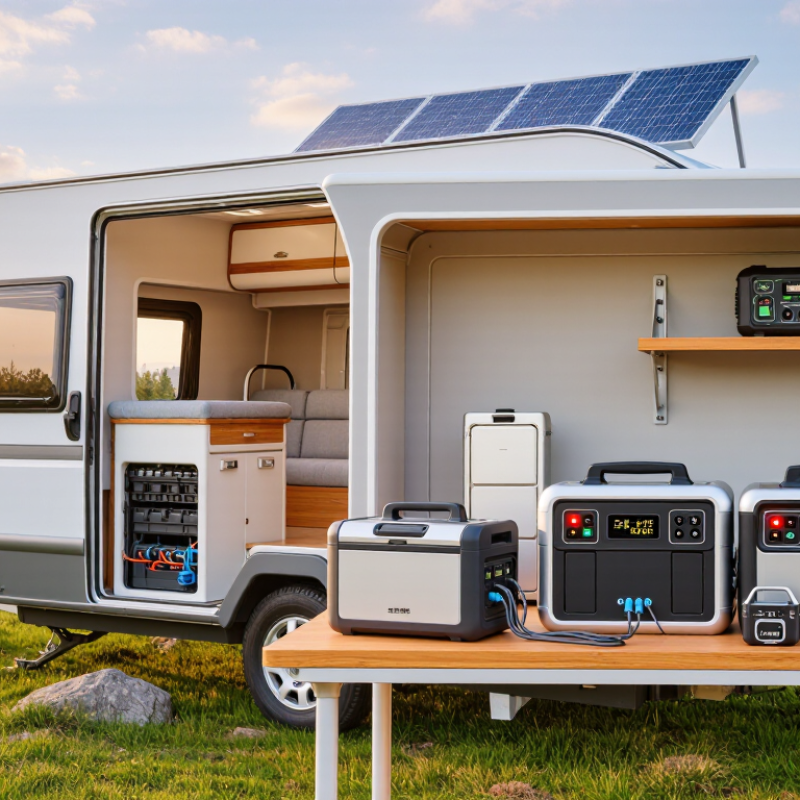
Caravan battery packs generally fall into three groups: flooded lead-acid, AGM or gel, and lithium iron phosphate. Flooded batteries cost less, but they need ventilation, regular checks, and careful positioning. AGM and gel packs are sealed, vibration-resistant, and practical for modest 12-volt loads. Lithium iron phosphate packs are lighter and usually provide more usable capacity. They also require a battery management system for cell balancing, temperature protection, and over-current control.
Core functions differ from simple energy storage. A caravan pack should run lights, water pumps, refrigeration, fans, and communication equipment without unstable voltage. An inverter can supply alternating-current appliances, but it increases losses. Charging may come from shore power, solar panels, or a vehicle alternator. In real use, a 100Ah lithium pack can feel stronger than a similar lead-acid unit because deeper discharge is normally available. Capacity figures can mislead.
The International Energy Agency reported that LFP batteries represented about 40% of the global electric-car battery market in 2023. That trend supports their growing use in mobile power systems, although caravan conditions differ. BloombergNEF’s 2024 Battery Price Survey placed the average lithium-ion pack price at 115 US dollars per kWh, down 20% from 2023. Smaller caravan packs often cost more per kWh. Cold mornings expose weaknesses. Lithium charging may require low-temperature protection, while lead-acid chemistry loses effective capacity. I once focused too heavily on amp-hours and overlooked cable length, fuse placement, and inverter surge demand. That was a costly calculation error.
| Rank | Battery Pack Type | Typical Configuration | Nominal Voltage | Typical Capacity | Approx. Nominal Energy | Recommended Usable Energy | Expected Cycle Life* | Core Function | Best Suited For | Important Buying Consideration |
|---|---|---|---|---|---|---|---|---|---|---|
| 1 | 12 V LiFePO4 Leisure Pack | 4-cell lithium iron phosphate pack with integrated BMS | 12.8 V | 100 Ah | 1.28 kWh | Approximately 1.0–1.15 kWh | 2,000–5,000 | Runs lights, water pumps, refrigerators, electronics and moderate inverter loads with stable voltage. | Most modern caravans and frequent off-grid travel | Confirm low-temperature charging protection, charger compatibility and continuous discharge current. |
| 2 | 12 V LiFePO4 High-Capacity Pack | 4-cell lithium iron phosphate pack with advanced BMS | 12.8 V | 200 Ah | 2.56 kWh | Approximately 2.05–2.30 kWh | 2,000–5,000 | Provides extended autonomy for high daily energy demand without frequent recharging. | Large caravans, remote travel and solar-supported systems | Check compartment dimensions, pack weight, ventilation requirements and alternator charging limits. |
| 3 | 12 V AGM Deep-Cycle Pack | Absorbent glass mat lead-acid battery, sealed construction | 12 V | 100 Ah | 1.20 kWh | Approximately 0.60 kWh at a conservative 50% depth of discharge | 400–800 | Supplies reliable auxiliary power and accepts relatively high charging currents. | Entry-level caravans and moderate seasonal use | Heavier than lithium and sensitive to repeated deep discharge; use a suitable multi-stage charger. |
| 4 | 12 V Gel Deep-Cycle Pack | Valve-regulated lead-acid battery using gelled electrolyte | 12 V | 100 Ah | 1.20 kWh | Approximately 0.60 kWh at a conservative 50% depth of discharge | 500–1,000 | Delivers steady low-to-medium current for appliances and onboard systems. | Low-maintenance installations with moderate charging rates | Requires a charger with a gel-compatible voltage profile and generally charges more slowly than AGM. |
| 5 | 12 V Flooded Lead-Acid Deep-Cycle Pack | Vented lead-acid battery with liquid electrolyte | 12 V | 100 Ah | 1.20 kWh | Approximately 0.60 kWh at a conservative 50% depth of discharge | 300–700 | Provides economical auxiliary power for basic caravan loads. | Budget installations with a dedicated, ventilated battery compartment | Requires ventilation, periodic electrolyte checks and careful handling because charging can produce hydrogen gas. |
| 6 | 24 V LiFePO4 Caravan Pack | 8-cell lithium iron phosphate pack with BMS | 25.6 V | 100 Ah | 2.56 kWh | Approximately 2.05–2.30 kWh | 2,000–5,000 | Reduces current on higher-power DC circuits and improves inverter efficiency compared with 12 V systems. | Large off-grid caravans and high-power electrical systems | All chargers, fuses, inverters and loads must be rated for 24 V; do not connect directly to 12 V equipment. |
| 7 | 48 V LiFePO4 Energy Pack | 16-cell lithium iron phosphate pack with monitoring system | 51.2 V | 100 Ah | 5.12 kWh | Approximately 4.10–4.60 kWh | 2,000–5,000 | Supports substantial inverter, solar and electric-mobility loads with lower cable current. | Specialist luxury caravans and large renewable-energy systems | Needs high-voltage-rated protection, isolation, cabling and professional system design. |
| 8 | Dual-Battery LiFePO4 Pack | Two matched 12.8 V batteries connected in parallel | 12.8 V | 200 Ah total | 2.56 kWh | Approximately 2.05–2.30 kWh | 2,000–5,000 | Provides expandable 12 V storage and can distribute heat and current across two units. | Systems requiring modular installation or easier physical handling | Use identical batteries of similar age, equal-length interconnect cables and appropriately sized protection. |
| 9 | Portable Power Station Pack | Integrated lithium battery, inverter, charger and DC outputs | Typically 12–51 V internally | 500–2,000 Wh | 0.50–2.00 kWh | Approximately 0.40–1.70 kWh, depending on inverter efficiency and reserve settings | 500–3,000 | Offers plug-and-play AC, USB and DC power without permanent caravan rewiring. | Short trips, rental caravans, emergencies and portable outdoor use | Check continuous AC output, surge rating, solar-input limits, operating temperature and local electrical approvals. |
| 10 | 12 V Starter-and-Leisure Combination Pack | Dual-purpose lead-acid battery designed for engine starting and auxiliary loads | 12 V | 75–100 Ah | 0.90–1.20 kWh | Approximately 0.30–0.50 kWh for regular cycling | 200–500 | Combines high short-duration starting current with limited leisure-power capability. | Small caravans with modest electrical demand and limited installation space | It is a compromise solution; a dedicated deep-cycle battery is normally better for repeated off-grid use. |
*Cycle-life figures are typical industry ranges and vary with depth of discharge, temperature, charging method, storage conditions and battery-management settings. Usable-energy estimates are approximate and exclude conversion losses unless stated.
Match the battery to the caravan’s voltage system, usually 12V or 24V. Check the charger, inverter, solar controller, and wiring. A mismatch can damage equipment. Capacity alone is not enough.
No. Continuous output matters more than peak power during heavy use. Two 100Ah batteries may perform differently under the same load. Laboratory ratings can feel optimistic inside a moving caravan.
Confirm the charger’s input voltage and frequency range. Check the plug type, charging profile, connector polarity, and cable connections. An adapter changes the plug shape, not the voltage.
Install a correctly rated fuse near the positive battery terminal. Secure the terminals and protect cables from sharp metal edges. Keep cables short, tight, and supported. Loose connections can create hidden heat.
Yes. Lithium batteries need suitable charging settings and a reliable management system. Lead-acid batteries require different control methods and proper ventilation. Never assume one charger suits every battery type.
Cold conditions can reduce performance and affect charging safety. Some lithium cells may suffer damage if charged below their allowed temperature. Check the battery limits before winter charging. Cold weather matters.
Remove appliances that continue drawing power. Keep lead-acid batteries fully charged and recharge them periodically. Lithium batteries often store well near 40–60% charge. Follow the stated storage limits instead.
Check resting voltage after the battery sits for several hours. Inspect terminals monthly for corrosion, swelling, and cracked cases. Record voltage, temperature, and charging dates. A dashboard display may look reassuring while capacity declines.
Shallower discharge cycles usually support longer service life, though results vary. Avoid leaving appliances connected overnight. I would recheck actual capacity under realistic loads. That simple check is easy to neglect.
Choosing the right Caravan Battery Pack is essential for reliable, comfortable, and safe travel. This guide explains the main battery types, their core functions, and the key specifications buyers should compare, including capacity, voltage, cycle life, charging speed, weight, temperature tolerance, and compatibility with caravan electrical systems. It also presents ten practical battery pack options designed for different travel needs, from short weekend trips to extended off-grid journeys, without focusing on any specific brand.
The article further covers global compatibility, charging standards, connector requirements, and important safety considerations for international buyers. Readers will learn how to plan installation, position batteries correctly, use suitable charging equipment, and protect the system from overheating, overcharging, deep discharge, and moisture. Regular inspection, balanced charging, proper storage, and responsible maintenance can help extend battery life, improve performance, and provide dependable power throughout every journey.

 Liao Battery