What Is a Power Tools Battery and How Does It Work?

Time:2026-09-20 Author:Sienna
0%

A Power Tools Battery stores electrical energy and releases it when a motor demands torque. In modern cordless tools, lithium-ion cells dominate because they offer high energy density, low self-discharge, and useful cycle life. The U.S. Department of Energy explains that lithium ions move between the anode and cathode during charging and discharging. This controlled movement creates the current that drives a drill, saw, or impact wrench.

It is the quiet engine.

Grand View Research estimated the global power tools market at approximately USD 36.2 billion in 2023. Its report also projects continued growth through 2030, supported by cordless equipment and construction demand. Market definitions vary, however, so these figures should guide evaluation rather than replace it. Battery performance depends on more than voltage. Cell chemistry, capacity, internal resistance, temperature, and the battery management system all affect real-world results. A 5.0 Ah pack may run a circular saw longer than a 2.0 Ah pack, but it usually adds weight.

Not quite simple.

The battery management system monitors voltage, current, and temperature. It can limit charging or shut down the pack when unsafe conditions appear. UL Solutions and the International Electrotechnical Commission publish safety frameworks relevant to rechargeable battery systems and portable tools. Their work reinforces one practical lesson: certified protection matters as much as advertised capacity. In a cold workshop, runtime may drop. Under heavy cutting, heat may build quickly. These details are easy to overlook, even in professional purchasing decisions. Understanding how a Power Tools Battery works helps users compare tools honestly, charge packs responsibly, and choose performance that fits the job.
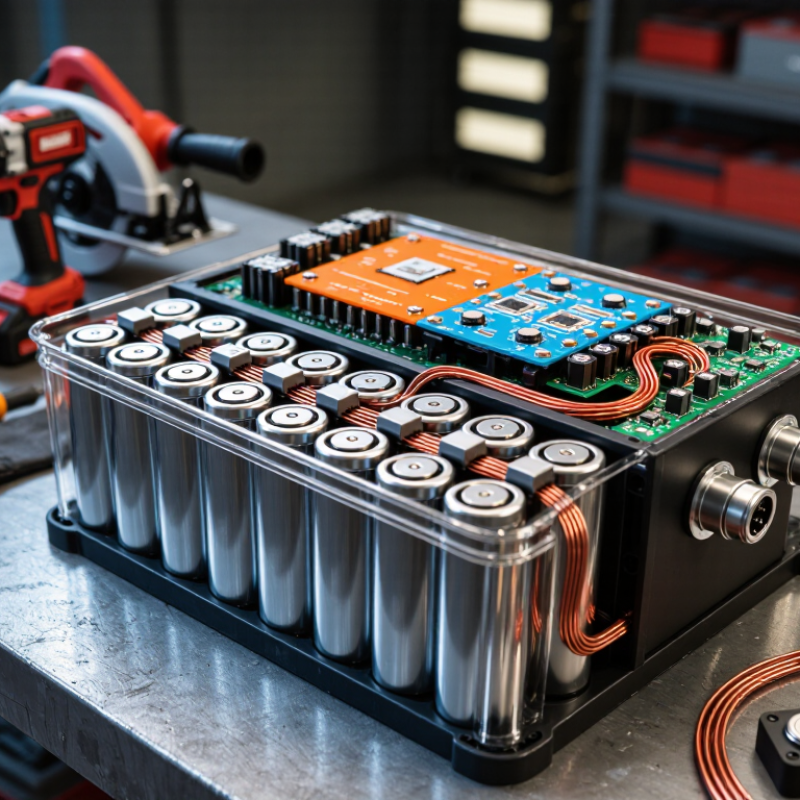
What Is a Power Tools Battery and How Does It Work?

Power Tool Batteries: Definition and Core Components

A power tool battery is a rechargeable energy pack that supplies controlled current to a motor. Most modern packs use lithium-ion cells because they offer high energy density and low self-discharge. The International Energy Agency reported average lithium-ion battery prices near $139 per kWh in 2023. That figure reflects larger batteries, but it shows the technology’s wider manufacturing trend.

The core component is the cell. Each cell contains a graphite anode, a metal-oxide cathode, an electrolyte, and a porous separator. Several cells connect in series to raise voltage. Parallel connections increase capacity. A plastic housing protects these parts from dust, impact, and moisture. Metal contacts transfer power to the tool. Small temperature sensors sit near the cells.

The battery management system is the control center. It monitors voltage, current, temperature, and charging balance. It can stop charging when one cell reaches its limit. The U.S. Department of Energy’s Battery Technology Status Report identifies these controls as essential for lithium-ion safety and service life. Yet battery packs are not perfectly predictable. Cold weather reduces output. Heat accelerates aging. A higher capacity rating may also increase weight and charging time. That trade-off is easy to overlook. In practical use, a pack may feel strong at first, then weaken sharply under heavy cutting or drilling loads. A 2024 Avicenne Energy review also highlights cell chemistry, pack design, and thermal control as major performance factors.

How Power Tool Batteries Store and Release Electrical Energy

What Is a Power Tools Battery and How Does It Work?

A power tool battery stores energy through reversible chemical reactions. Most modern packs use lithium-ion cells. Each cell contains a negative electrode, a positive electrode, an electrolyte, and a separator. During charging, lithium ions move toward the negative electrode. During use, they travel back through the electrolyte. Electrons move through the tool’s circuit instead. This flow powers the motor.

Battery capacity is measured in ampere-hours, or Ah. Voltage describes electrical pressure. Watt-hours estimate stored energy: voltage multiplied by Ah. A 20-volt, 5-Ah pack therefore stores about 100 Wh under rated conditions. Actual output changes with temperature, battery age, and motor load. A simple voltage reading can mislead.

The International Energy Agency reported a 14% fall in lithium-ion battery pack prices during 2023. This reflects broader battery manufacturing trends, not a guarantee for every tool pack. The U.S. Department of Energy’s Battery500 Consortium targets 500 Wh/kg at cell level. That remains a research goal, not typical workshop performance. Battery management systems monitor voltage, temperature, and current. They can limit charging or discharge when conditions become unsafe. Designs aligned with IEC 62133-2 also address portable battery safety.

Tips: Keep contacts clean and dry. Let a hot pack cool before charging. Avoid storing it completely empty. Check the charger’s compatibility. These habits help, though they cannot reverse normal cell aging.

Battery Chemistry and Its Effect on Tool Performance

A power tool battery stores chemical energy and releases it as controlled electrical current. Inside each cell, lithium ions move between electrodes during charging and use. A battery-management system monitors voltage, temperature, and current. It also limits unsafe charging or excessive discharge. Chemistry matters.

Nickel-manganese-cobalt lithium-ion cells usually provide high energy density and strong short bursts. That suits drills, saws, and impact tools requiring sudden torque. Lithium-iron-phosphate cells generally offer better thermal stability and longer cycle potential, but their lower voltage and energy density can increase pack size. The International Energy Agency reported that LFP batteries reached about 40% of global electric-vehicle battery deployment in 2023, showing their growing industrial importance beyond small tools. These figures do not directly represent tool batteries, but they indicate broader manufacturing momentum.

Temperature changes performance sharply. A cold pack may make a drill sound strained, while a hot pack can trigger electronic protection. The U.S. Department of Energy’s Battery500 research emphasizes improving energy density, safety, and cycle life together, rather than chasing one number. A higher capacity rating does not guarantee stronger cutting power. Internal resistance, cell matching, wiring, and software also matter. Heat changes everything. A workshop comparison can be useful, yet imperfect: the same pack may perform differently after ten minutes of cutting, especially in dust or freezing weather. Reports from the International Energy Agency and the U.S. Department of Energy support the chemistry trade-offs, but actual results still depend on cell design and operating conditions.

How a Battery Powers a Cordless Tool Step by Step

What Is a Power Tools Battery and How Does It Work?

How a Battery Powers a Cordless Tool Step by Step

A cordless tool starts working when its battery slides into the tool’s contact rails. Inside the pack, several rechargeable cells store electrical energy through chemical reactions. The battery management circuit monitors voltage, temperature, and current. This small circuit matters. It helps prevent overheating and excessive discharge.

When you press the trigger, electrical current travels through the contacts and into the control board. The board regulates the power before sending it to the motor. Higher trigger pressure usually allows more current to flow. The motor then turns electrical energy into spinning force. Gears transfer that force to a drill bit, blade, or fastening head. You can often hear this change as the motor moves from a soft hum to a sharper whine.

During heavy work, such as driving a long screw into dense wood, the motor demands more current. The battery voltage may drop slightly under that load. Heat also builds near the cells and motor. That is normal within safe limits, but repeated overheating can reduce battery life. Charging reverses the chemical process, while the charger adjusts current as the cells become full. A cooler battery usually charges more safely.

Many users assume a larger battery always means more power. That is not fully correct. Capacity mainly affects working time, while voltage influences available force. Real performance also depends on the tool’s motor, gears, and condition. The system is efficient, but never perfect.

What Is a Power Tools Battery and How Does It Work? — How a Battery Powers a Cordless Tool Step by Step
Step Component or Stage Typical Data or Function How It Contributes to Tool Operation
1 Rechargeable Battery Pack Lithium-ion cells
Common pack voltages: approximately 12 V, 18 V, 20 V maximum, or 36 V
The battery pack stores electrical energy in rechargeable cells. Pack voltage depends on the number of cells connected in series, while the available capacity depends on the cells’ ampere-hour rating and configuration.
2 Cell Chemistry Lithium-ion chemistry
Nominal cell voltage: about 3.6–3.7 V
Fully charged cell voltage: about 4.2 V
During discharge, lithium ions move internally between the negative and positive electrodes while electrons travel through the external circuit to deliver useful electrical power.
3 Battery Management System Monitors voltage, current, temperature, and cell balance The management system helps protect the pack from overcharging, excessive discharge, excessive current, and unsafe temperature conditions. It may disconnect the output when a limit is reached.
4 Electrical Contacts Positive and negative power terminals; some packs include communication contacts When the pack is correctly installed, the terminals create a low-resistance connection between the battery and the tool. Additional contacts can allow the tool and battery electronics to exchange monitoring information.
5 Trigger and Control Circuit Electronic switching regulates current supplied to the motor Pressing the trigger sends a control signal. The tool’s electronics then connect and regulate battery power, allowing variable speed, soft starting, braking, or other control functions depending on the tool design.
6 Brushless or Brushed Motor Converts electrical energy into rotational mechanical energy Current creates magnetic forces inside the motor. These forces produce torque, which turns the motor shaft. Brushless motors use electronic commutation, while brushed motors use brushes and a mechanical commutator.
7 Gearbox and Output Mechanism Adjusts speed and torque for the application Gears can reduce rotational speed while increasing output torque. The final mechanism transfers motion to the bit, blade, chuck, drive spindle, or other working attachment.
8 Power Relationship Electrical power ≈ voltage × current

Energy ≈ voltage × ampere-hours
A higher load generally requires more current. For example, a 4 Ah pack at a nominal 18 V stores approximately 72 Wh before accounting for conversion losses, cut-off limits, temperature, and battery age.
9 Runtime Factors Load, operating speed, material resistance, temperature, battery age, and tool efficiency Runtime is not determined by ampere-hours alone. Heavy cutting, drilling, or driving loads consume energy faster than light-duty operation, and cold or aging cells may deliver less usable capacity.
10 Charging Process Constant-current and constant-voltage charging are commonly used for lithium-ion packs The charger supplies controlled current until the pack approaches its target voltage, then reduces current while maintaining the voltage limit. Charging should be performed with a compatible charger in a suitable temperature range.
11 Thermal Protection Temperature sensors and electronic cut-off protection High current and demanding work generate heat. The battery or tool may reduce output or stop temporarily if temperatures become too high or too low for safe operation.
12 Safe Handling Keep terminals dry and protected; avoid crushing, puncturing, short-circuiting, or unauthorized disassembly Physical damage or electrical abuse can cause overheating, fire, or cell failure. Store and transport rechargeable packs according to the applicable safety instructions and local regulations.

Charging, Safety, Maintenance, and Battery Lifespan

What Is a Power Tools Battery and How Does It Work?

Charging, Safety, Maintenance, and Battery Lifespan

A power tool battery stores electrical energy in rechargeable cells. Most modern packs use lithium-ion chemistry. A charger controls voltage and current during charging. Use only a charger designed for the battery’s specifications. Charging on a hard, dry surface is safer than charging on fabric or a workbench covered with dust. Keep the battery away from direct sunlight and freezing temperatures. Never charge a pack that is cracked, swollen, leaking, or unusually hot. Stop immediately.

In workshop practice, temperature tells a useful story. A slightly warm battery can be normal after use. Excessive heat, a sharp smell, or strange noise is not. Let the pack cool before charging it. Avoid covering the charger while it operates. Do not leave charging batteries unattended for long periods. Modern chargers usually stop automatically, but that feature is not permission to ignore basic care. Check the user manual for exact instructions.

Wipe the contacts with a clean, dry cloth. Keep metal objects away from the terminals. Store the battery partly charged in a cool, dry cabinet. Full discharges can shorten its working life, so recharge it before it becomes completely empty.

Heat causes faster aging. So does repeated heavy use. I once stored a battery in a hot vehicle, and its runtime later dropped noticeably. That mistake was avoidable. Even careful users should inspect batteries regularly, because appearance can change before performance does.

FAQS

What does a cordless tool battery do?

It stores chemical energy and releases controlled electrical current. Inside, lithium ions move between electrodes. Small changes matter.

How does a battery start a cordless tool?

The pack connects through contact rails. Current reaches the control board, then the motor. Gears transfer rotation to a bit, blade, or fastening head.

What does the battery-management system control?

It monitors voltage, temperature, and current. It can limit unsafe charging or excessive discharge. This protection helps, but it cannot fix every battery problem.

How do battery chemistries affect tool performance?

Nickel-manganese-cobalt cells often deliver strong bursts and high energy density. They suit drills, saws, and impact tools. Lithium-iron-phosphate cells usually offer better thermal stability and cycle potential. Their packs may be larger.

Does a larger capacity rating mean more cutting power?

Not always. Capacity mainly affects working time, while voltage influences available force. Motor design, gears, wiring, cell matching, and software also matter. Bigger is not automatically stronger.

Why does cold weather reduce tool performance?

A cold battery may deliver current less effectively. The drill can sound strained during demanding work. Let the pack warm gradually before heavy use. Avoid guessing from sound alone.

What happens when a tool works under heavy load?

Driving a long screw into dense wood increases current demand. Voltage may drop slightly, while heat builds near the cells and motor. Some heat is normal. Repeated overheating can shorten battery life.

How should a battery be charged after use?

Charging reverses the chemical process. The charger adjusts current as the cells approach full charge. A cooler battery generally charges more safely. Real workshop conditions are messier.

Conclusion

A Power Tools Battery is a rechargeable energy source designed to provide portable electricity for cordless tools. Its main components typically include electrochemical cells, protective circuitry, terminals, and a housing that keeps the internal parts secure. During charging, electrical energy is converted and stored as chemical energy inside the cells. When the tool is switched on, this process reverses: the battery releases electrical energy, which flows through the tool’s control system to drive the motor and produce useful mechanical power.

Battery chemistry strongly affects performance, influencing runtime, power output, weight, charging speed, and service life. In normal operation, the battery sends energy through its terminals while built-in controls help manage temperature, current, and voltage. Safe charging requires a compatible charger, proper ventilation, and attention to warning signs such as swelling or unusual heat. Regular maintenance, including keeping contacts clean, storing the battery in moderate conditions, and avoiding complete discharge, can help preserve capacity. With careful use and timely charging, a quality Power Tools Battery can deliver dependable performance over many work cycles.


Sienna

Sienna

Sienna is a skilled marketing professional with a deep expertise in our company’s core products and services. With a passion for innovation and detail, she plays a pivotal role in crafting insightful blog posts that not only highlight the unique features of our offerings but also provide valuable......